Former Lok Sabha Speaker Meira Kumar presided over the INDIA bloc’s symbolic hearing against CEC Gyanesh Kumar on 31 October 2026, while Congress president Mallikarjun Kharge moved its motion. Rahul Gandhi and Sonia Gandhi were present, according to NDTV. These were roles at a political event, not the exercise of parliamentary removal powers.
Who is Meira Kumar?
Meira Kumar served as Speaker of the 15th Lok Sabha and was the first woman to hold that office. Parliament’s historical material records her place in the institution’s history, while PRS lists her 15th Lok Sabha membership from Sasaram in Bihar. Her former position explains the parliamentary association that her participation brought to the event.
“Former Speaker” is the essential description. Holding that office in the past does not give a person continuing authority to convene an official sitting of the Lok Sabha or admit a removal notice on its behalf. Her role at the residence hearing should therefore be described as presiding over the organisers’ proceedings.
What did presiding mean at this event?
The Hindu’s live record identified Kumar as opening the proceedings. Moneycontrol’s advance account described a programme involving political representatives, civil society and people affected by SIR. Those choices gave the gathering a recognisable structure for presenting complaints about electoral rolls.
An event chair can regulate the organisers’ speaking sequence. That is different from the constitutional office of the Speaker or the statutory role of a presiding officer examining a formal notice. The similarity of language should not be allowed to obscure the difference in authority.
This distinction is especially useful when short clips circulate without context. A video of a person announcing a motion may establish that the announcement happened. It does not, on its own, establish that the motion was admitted in Parliament, that all allegations were proved or that an official order followed.
What was Kharge’s role?
Kharge hosted the proceedings at his New Delhi residence and moved the symbolic motion, according to the accounts checked. Moving a motion sets out the proposition that an event is being asked to discuss. It should not be mistaken for a verified finding simply because the allegation is expressed in formal language.
Readers assessing the substance should look beyond the identity of the mover. Which document supports a charge? Does it identify a particular decision? Has the institution concerned responded? Does the response address the specific issue or only the general political accusation? Those questions remain relevant whoever delivers the speech.
What is confirmed about Rahul and Sonia Gandhi?
NDTV’s report confirmed their presence. Moneycontrol’s advance report assigned Rahul Gandhi the concluding remarks, but an announced role is not proof of the final speech. Presence at the opening, an expected speaking role and an actually delivered speech are different facts. This report does not turn an announced programme into a transcript of remarks that had not been verified by its cut-off.
For the same reason, an invitation list should not be published as a final attendance register. A complete account would need to distinguish the people present, the people who spoke, and groups merely reported as intending to participate. Political alliances can also overlap with support for a single protest without every supporting group sharing the same organisational membership.
Why the venue and title need context
The hearing was held at Kharge’s residence, not in the parliamentary chambers. The label “public impeachment” describes the organisers’ political framing. Article 324(5) and the 2023 Election Commissioners law reserve actual CEC removal to a different constitutional process.
A careful account can acknowledge the event’s public significance while keeping its institutional limits clear. It can report a complaint, an answer and an unresolved question without announcing a verdict. The most useful follow-up would link the full proceedings and any published resolution, then independently check the factual claims raised there.
Frequently asked questions
Was Meira Kumar acting as the current Lok Sabha Speaker?
No. She participated as a former Speaker presiding over the symbolic political event.
Who moved the motion at the hearing?
Congress president Mallikarjun Kharge moved the symbolic motion, according to the reports checked.
Does the presence of MPs make this an official Parliament sitting?
No. The identity of the participants does not convert a meeting at a residence into proceedings of either House.
Sources and reporting notes
Moneycontrol: announced speaking roles and programme
The Hindu: live record of the opening proceedings
Lok Sabha Secretariat: historical account of Speakers
PRS: Meira Kumar’s 15th Lok Sabha record
India Code: 2023 Act, section 11
Reporting cut-off: 31 October 2026, 4:40 p.m. IST. This article distinguishes reported developments, political allegations and the applicable legal framework. It does not report a final outcome of the symbolic hearing.
Image source
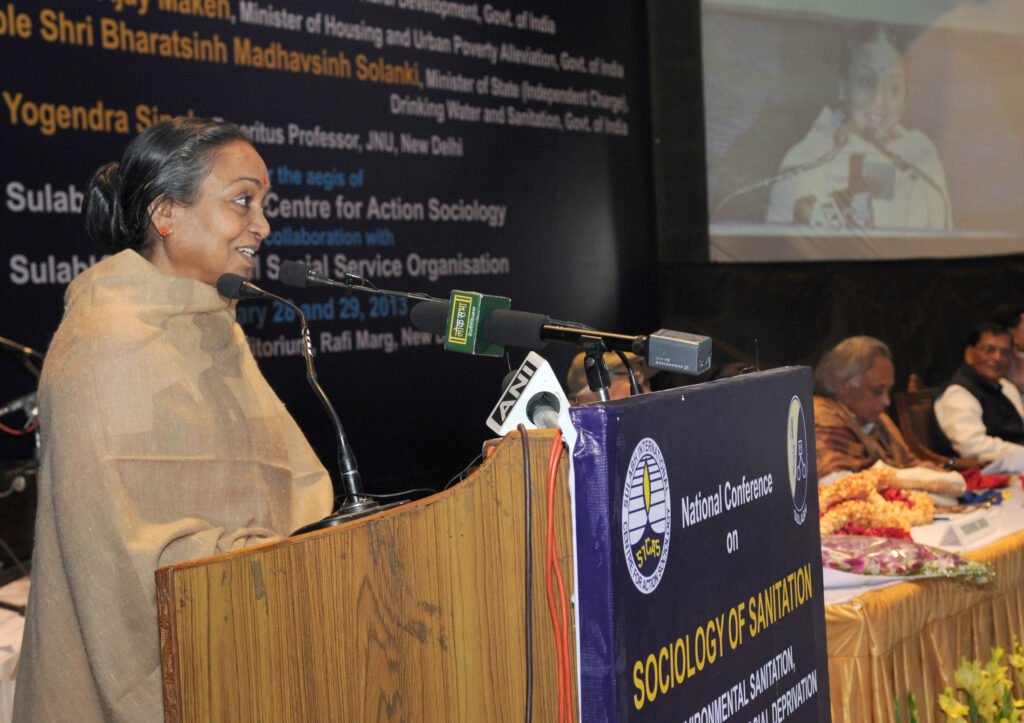
Meira Kumar addressing a conference in New Delhi, 28 January 2013. Archive photograph; not the 31 October 2026 hearing. Photo: Ministry of Parliamentary Affairs / Wikimedia Commons · GODL-India. Display crops may be applied.