A Chief Election Commissioner cannot be removed by a symbolic public hearing. Article 324(5) of the Constitution applies the removal protection of a Supreme Court judge to the CEC. That brings into view a demanding process involving scrutiny of the charges, both Houses of Parliament and the President, rather than a political declaration alone.
Which law governs removal?
Article 324(5) supplies the constitutional safeguard. Section 11(2) of the Chief Election Commissioner and Other Election Commissioners (Appointment, Conditions of Service and Term of Office) Act, 2023 repeats it. Article 124(4), which concerns Supreme Court judges, specifies the grounds and parliamentary voting requirements. The Judges (Inquiry) Act, 1968 provides the inquiry procedure discussed in the removal framework.
The Indian Express explainer supplied for this report sets the opposition’s symbolic proceedings against that legal background. The primary texts are linked below so readers can distinguish the law itself from shorthand descriptions in political debate.
Step one: a notice is not a removal vote
Under section 3 of the Judges (Inquiry) Act, the notice threshold is at least 100 Lok Sabha members or at least 50 Rajya Sabha members, depending on the House in which notice is given. Those are alternative starting thresholds for the respective Houses. They are not a rule requiring every initiative to begin with 150 signatures collected across both Houses.
The presiding officer may admit or refuse the notice. Crossing a signature threshold therefore does not mean the charges have been accepted as true. It also does not mean that the required parliamentary vote has already been won. A headline about submitting a notice describes an earlier stage than a headline about an admitted proceeding.
Step two: scrutiny of the charges
The statutory inquiry structure uses a three-member committee: a Supreme Court judge, a High Court Chief Justice and a distinguished jurist. Investigation and an opportunity to answer the charges are part of the process. An adverse finding permits further parliamentary consideration; it is not itself the final act of removal.
This is why “alleged misbehaviour” and “proved misbehaviour” cannot be used interchangeably. A political disagreement, a contested administrative choice and a legally established ground of removal are different propositions. Reporting should identify which proposition a document or speaker is actually advancing.
Step three: both parliamentary thresholds matter
Article 124(4) requires support in each House from a majority of that House’s total membership and at least two-thirds of members present and voting. Both conditions must be met. The address must be presented to the President in the same session, and removal is by presidential order on the specified grounds of proved misbehaviour or incapacity.
Consider a purely illustrative chamber with a total membership of 100 and 60 members present and voting. Two-thirds of 60 is 40, but 40 would not satisfy a majority of the total membership. At least 51 affirmative votes would be necessary in that example. This is arithmetic to explain the dual requirement, not a calculation of the current Lok Sabha or Rajya Sabha numbers.
Why a public hearing is legally different
The INDIA bloc’s 31 October event at Kharge’s residence used parliamentary symbolism. It was not either House of Parliament conducting the constitutional process. The presence of MPs or a former Speaker does not convert a public meeting into an official sitting, and a symbolic motion does not become a presidential removal order.
The event may still seek to influence opinion or press for formal action. Its political significance should be assessed on that basis. Describing its legal limits does not decide whether the allegations are correct; it identifies the institutions that would have to act for removal to occur.
Frequently asked questions
Is a simple majority enough to remove the CEC?
No. The constitutional framework requires both voting conditions in each House and the further presidential step.
Are 100 Lok Sabha and 50 Rajya Sabha signatures both required to start?
The notice rule specifies 100 members for a Lok Sabha notice or 50 for a Rajya Sabha notice. Admission and the final votes are separate stages.
Do other Election Commissioners have exactly the same removal protection?
Article 324(5) and section 11 distinguish them: other Election Commissioners cannot be removed except on the CEC’s recommendation. That is different from the CEC’s judge-like removal safeguard.
Sources and reporting notes
Constitution of India: Articles 124(4)–(5) and 324(5)
India Code: 2023 Act, section 11
India Code: Judges (Inquiry) Act, sections 3–6
Indian Express: the event and CEC removal explainer
Reporting cut-off: 31 October 2026, 4:40 p.m. IST. This article distinguishes reported developments, political allegations and the applicable legal framework. It does not report a final outcome of the symbolic hearing.
Image source
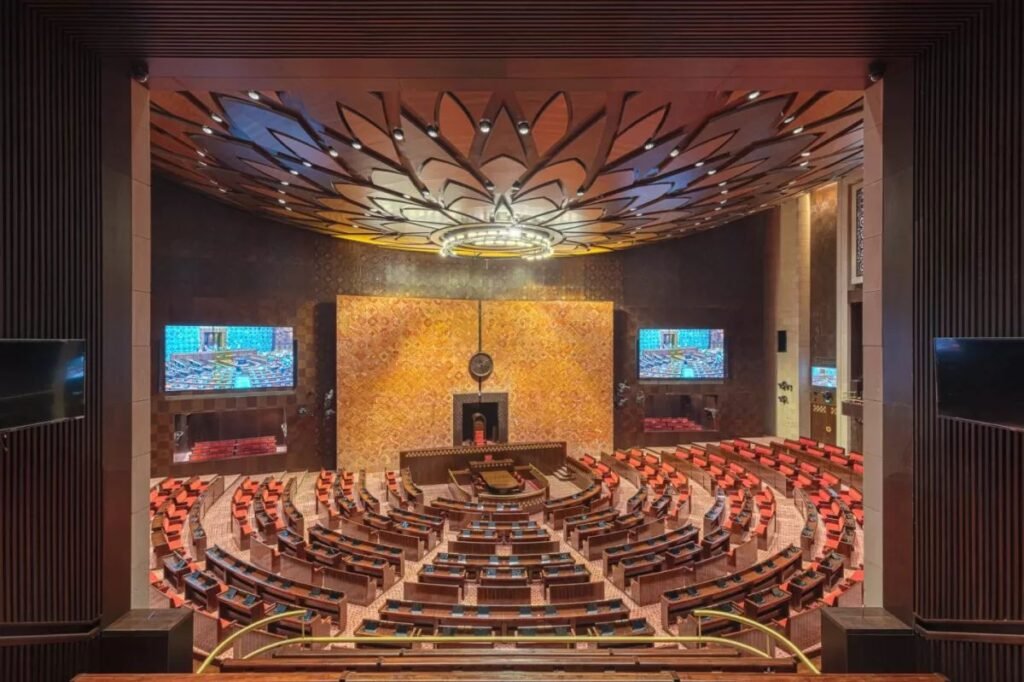
The Rajya Sabha chamber in the new Parliament building. Archive institutional photograph; not a CEC removal proceeding. Photo: Ministry of Parliamentary Affairs / Wikimedia Commons · GODL-India. Display crops may be applied.